Israelis Face Election With No Clear Winner and High Personal Stakes
Polls show a split parliament ahead, forcing potential minority rule while Prime Minister Netanyahu faces corruption trials and war crimes warrants.
By Alexander Wright ·
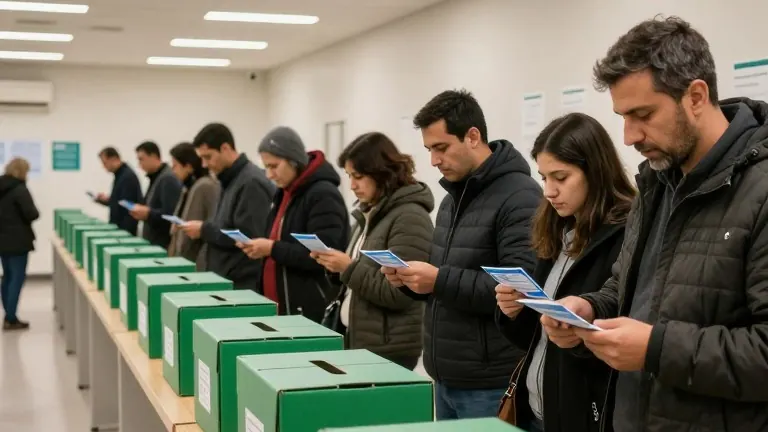
Israelis go to the polls on Tuesday for the first national election since the Hamas-led attacks of October 7, 2023. The vote determines the next government for a country managing long-running conflicts and deep internal divisions. Neither of the two main political blocs appears capable of winning a outright majority, setting the stage for complex coalition negotiations or a repeat election.
A survey conducted by public broadcaster KAN before a publication ban took effect on Friday provides the latest numerical outlook. The poll projects 52 seats for the opposition alliance and 50 seats for the bloc supporting Prime Minister Benjamin Netanyahu. The remaining 18 seats in the 120-seat Knesset would go to unaffiliated parties, including the two major Arab-led lists, Ra'am and the Joint List. A party must secure at least 3.25 percent of the vote to enter parliament, which serves a four-year term.
The pro-Netanyahu coalition consists of his Likud party, far-right groups, and ultra-Orthodox parties. United Torah Judaism and Shas join the alliance, along with Otzma Yehudi and Religious Zionism-Zehut. The latter group is led by ministers Itamar Ben-Gvir and Bezalel Smotrich. The opposition brings together four Jewish-led movements: the Yashar party of former military chief Gadi Eisenkot, the Democrats led by former deputy chief of staff Yair Golan, and Yisrael Beiteinu led by Avigdor Lieberman. The Together alliance of former Prime Minister Naftali Bennett has also joined, with opposition leader Yair Lapid attached to the group.
Both major blocs have stated they will not form a coalition with the Arab-led parties for the time being. This exclusion creates a mathematical challenge, as the two main groups fall short of the 61 seats required for a majority. This gap raises the prospect of a minority government governed by external support or a second election within months.
Domestic issues drive voter anger. Many citizens demand accountability for security failures that preceded the October 2023 attacks. The military exemption enjoyed by the ultra-Orthodox community remains a point of contention. Critics also oppose Netanyahu's judicial reforms, which they argue weaken Israel's liberal democratic order. Mairav Zonszein, a senior analyst at the International Crisis Group, noted that secular and liberal opposition factions view this election as the final opportunity to preserve the democratic system.
Israel's international standing has declined during the campaign. Several allies have imposed sanctions on illegal settlements in the occupied West Bank, and many nations have condemned continued attacks in Gaza and Lebanon. During the UN General Assembly on September 24, dozens of envoys left Netanyahu's address, with some booing and jeering.
The stakes are personal for Netanyahu, who has served as prime minister for more than 15 of the last 17 years. He faces corruption charges he has contested since 2019, alongside scrutiny over the pre-attack security lapses. A loss in the election would leave him more vulnerable in his ongoing trial, which could result in a prison sentence if he is convicted. He is also subject to an arrest warrant from the International Criminal Court for war crimes.
Approximately 7.3 million Israeli citizens are eligible to vote, including about 1.2 million Palestinian citizens of Israel. Polls suggest turnout among Palestinian citizens could reach 60 percent, potentially securing as many as 15 seats for Arab parties. Campaigners aim for 70 percent turnout, which would be the highest in decades. The Central Elections Committee barred the Joint List and Ra'am last month, but the Supreme Court reversed that decision. The court did, however, disqualify Balad leader Sami Abu Shehadeh over an article describing the October 7 attacks as an important historical event.
Netanyahu argues that his rivals will eventually partner with Arab parties, claiming only Likud can prevent that outcome. Joseph Mansour, a former aide to Knesset member Ayman Odeh, described this as a strategy to keep Netanyahu in office as a caretaker prime minister if no bloc wins a majority. Meanwhile, roughly three million adult Palestinians in Gaza, the occupied West Bank, and occupied East Jerusalem have no vote in selecting the government that controls their borders and legal status.
Source: Al Jazeera